

Mobile Robots for Hospital Food Service
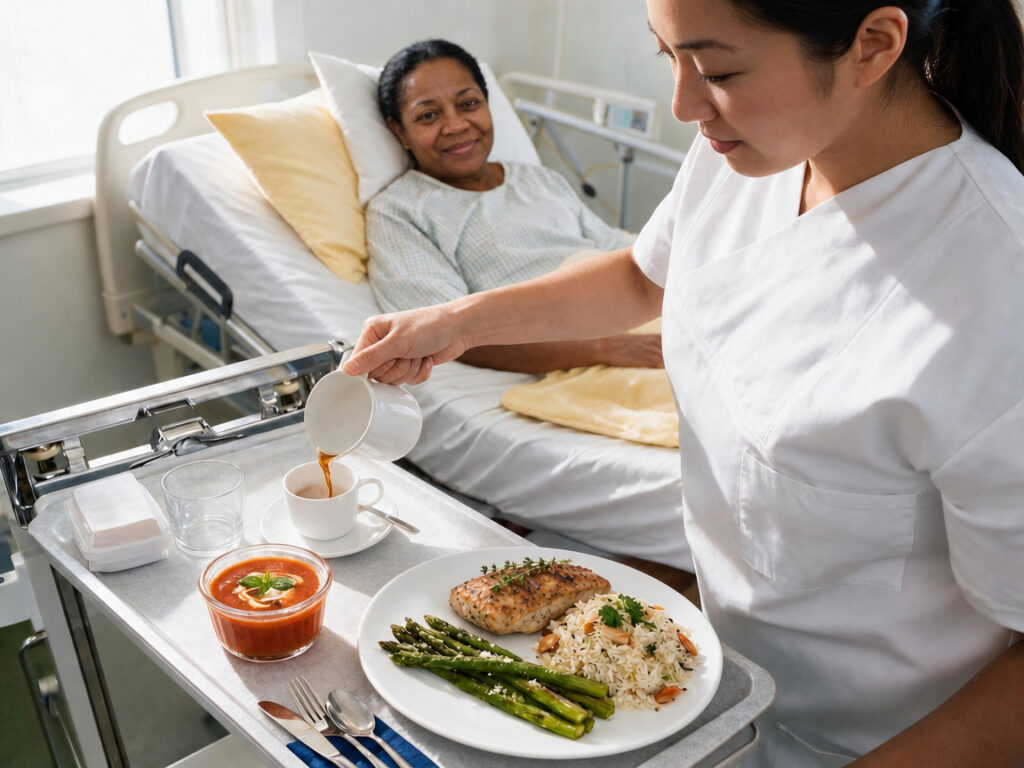
Your dietary team should be serving patients not pushing carts.
A meal that comes off the line hot and arrives cold isn’t a cooking problem.
It’s a transportation problem.
Aethon’s T3 autonomous mobile robots transport meal carts from the kitchen to the nursing unit and return finished trays to the dishroom. It does this for every meal service, room service dispatch, at night, on weekends and over holidays so you can focus your team on what’s most important.
MADE IN THE USA
and trusted
20+ YEARS
implmenting robots in healthcare
OMNIDIRECTIONAL
Nimble and safe – even with the largest loads
HANDS-FREE
Cart pickup and dropoff
Mobile Robots for Hospital Food Service
Your dietary team should be serving patients not pushing carts.
A meal that comes off the line hot and arrives cold isn’t a cooking problem.
It’s a transportation problem.
Aethon’s T3 autonomous mobile robots transport meal carts from the kitchen to the nursing unit and return finished trays to the dishroom. It does this for every meal service, room service dispatch, at night, on weekends and over holidays so you can focus your team on what’s most important.
MADE IN THE USA
and trusted
20+ YEARS
implmenting robots in healthcare
OMNIDIRECTIONAL
Nimble and safe – even with the largest loads
HANDS-FREE
Cart pickup and dropoff
Today, every cart that moves takes somebody with it.
Floor by floor, unit by unit, foot by foot, your staff is reduced to a logistics department rather than amplified as the critical nutrition service it is.
You already run the hardest food service operation there is. Three meal periods. Modified diets. Allergen accuracy. Room service orders arriving whenever the patient is hungry, not on a set schedule. Dishes and flatware that has to be turned before the next round starts. Your team does all of it under a clock that never stops.
And then, on top of all of it, somebody has to push the cart.
What the cart is actually costing you:
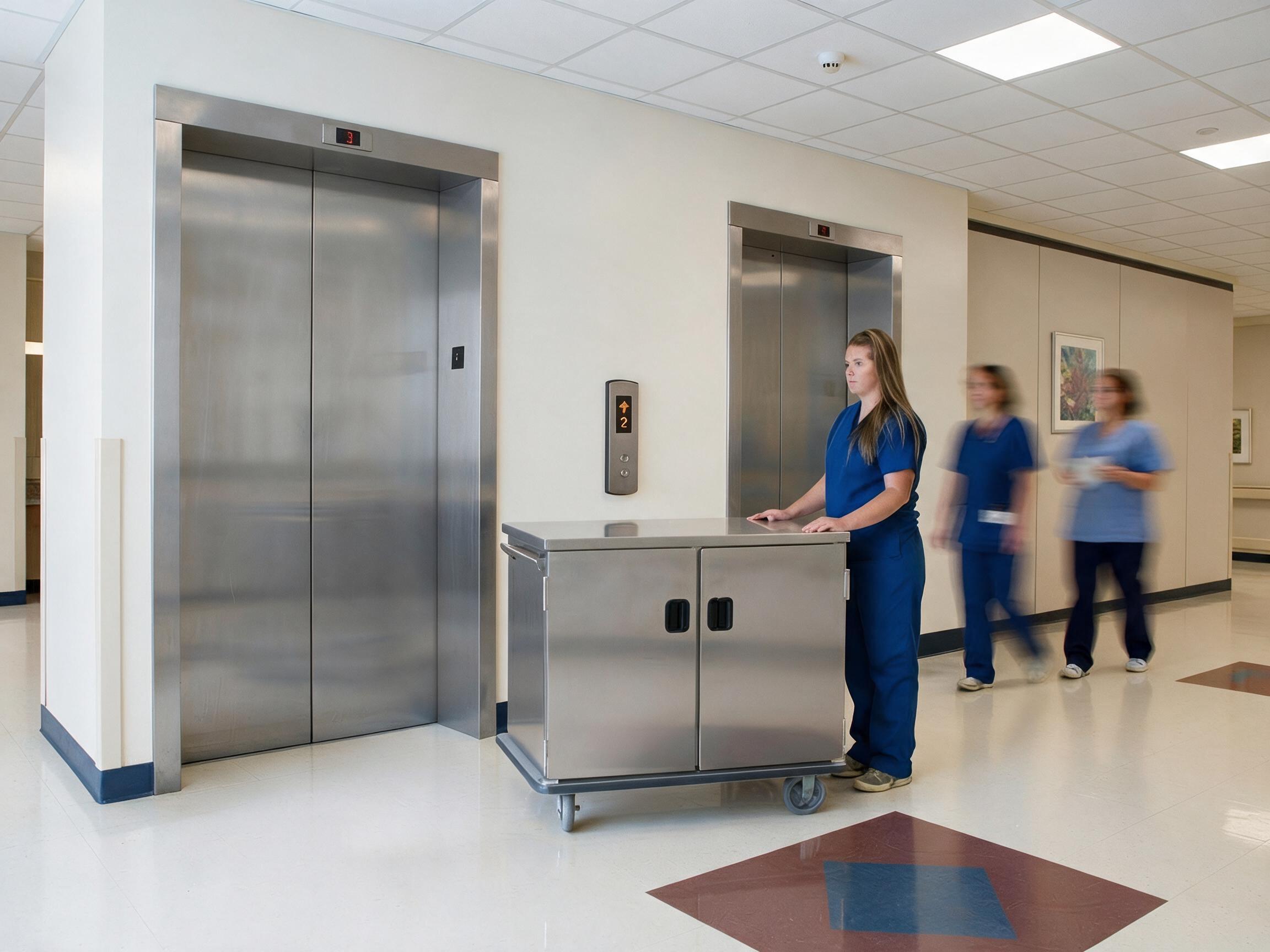
✓ Hours every shift spent walking loaded carts to units and empties back to the kitchen
✓ Late trays and cold plates when a cart waits for staff, or staff waits for an elevator
✓ Soiled trays sitting on a unit long past the point it is acceptable
✓ Room service models that promise on-demand delivery your staffing can’t reliably keep
✓ Nights, weekends and holidays that still need full coverage from a schedule you can barely fill
✓Overtime and agency labor you have to justify in the next budget cycle
✓ Good people who leave because the job turned out to be pushing 300 pounds of steel up a corridor
Your team is graded on a meal it was unable to control the moment it left the line.
You can't hire your way out of this.
Today, every cart that moves takes somebody with it.
Floor by floor, unit by unit, foot by foot, your staff is reduced to a logistics department rather than amplified as the critical nutrition service it is.
You already run the hardest food service operation there is. Three meal periods. Modified diets. Allergen accuracy. Room service orders arriving whenever the patient is hungry, not on a set schedule. Tracking consumption. Dishes and flatware that has to be turned before the next round starts. Your team does all of it under a clock that never stops.
And then, on top of all of it, somebody has to push the cart.
You can't hire your way out of this.
What the cart is actually costing you:
✓ Hours every shift spent walking loaded carts to units and empties back to the kitchen
✓ Late trays and cold plates when a cart waits for staff, or staff waits for an elevator
✓ Soiled trays sitting on a unit long past the point it is acceptable
✓ Room service models that promise on-demand delivery your staffing can’t reliably keep
✓ Nights, weekends and holidays that still need full coverage from a schedule you can barely fill
✓Overtime and agency labor you have to justify in the next budget cycle
✓ Good people who leave because the job turned out to be pushing 300 pounds of steel up a corridor
Your team is graded on a meal it was unable to control the moment it left the line.
MEAL DELIVERY & TRAY RETRIEVAL
This is a transportation problem that got handed to your food service department.
Eliminate it with autonomous mobile robots.
You and your team know how to create menus, plate a modified diet, hold temperature, and turn a dish room. That’s the work. That’s what they trained for and what they’re good at.
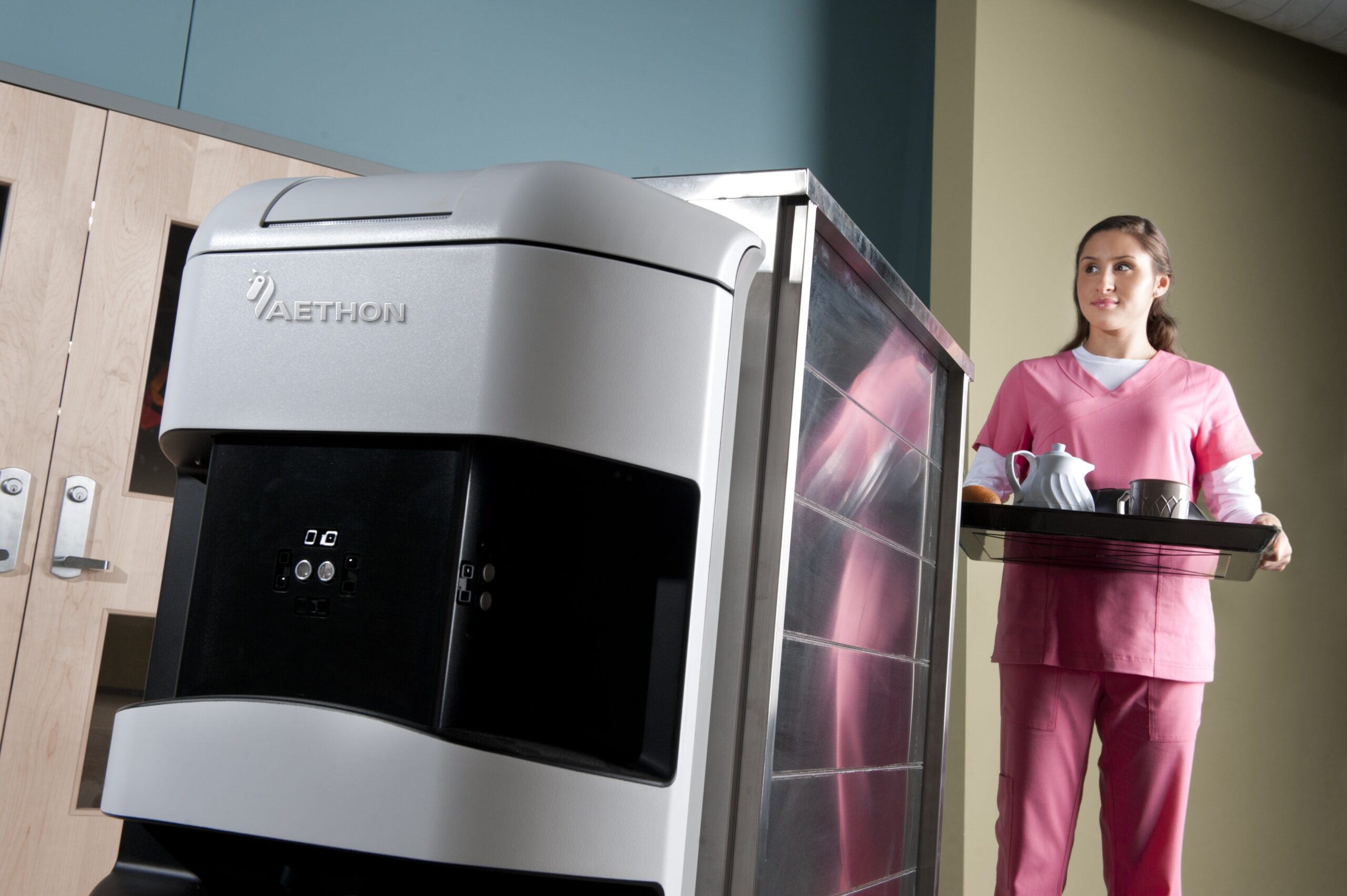
What breaks the operation is everything around it: walking the cart to the tower, waiting on the service elevator, walking back for the second cart, and returning at the end of the round for the trays that should have come back twenty minutes ago.
T3 does that part.
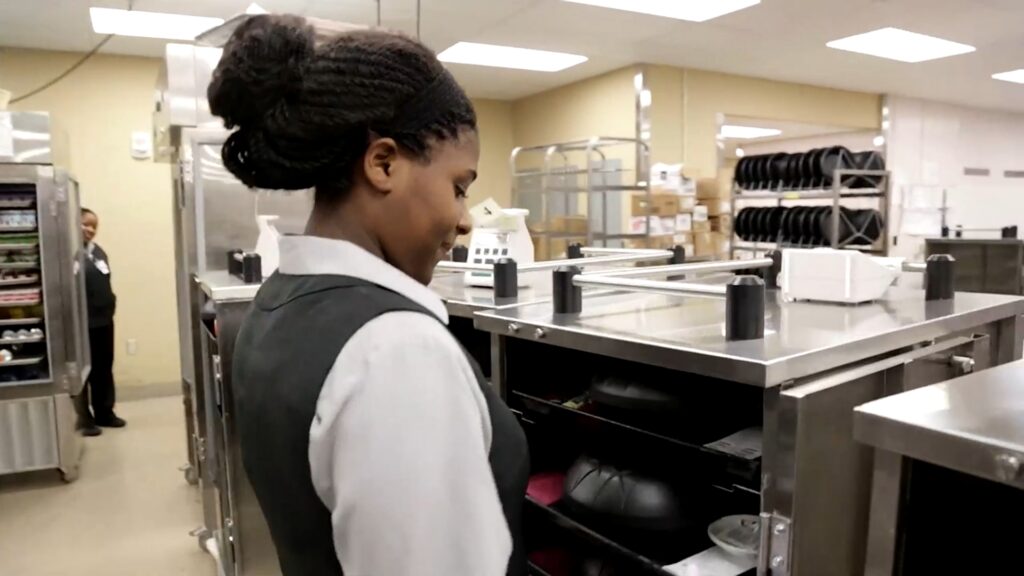
It finds the cart, drives underneath it, lifts it, and takes it where it’s supposed to go. It comes back for the empties. It does the same thing at 6 a.m. Sunday morning that it does at noon on a Tuesday.
T3 moves the carts. Your team serves the meal.
✓ Meal rounds that start on time because the cart is already there
✓ Predictable and consistent tray retrieval instead of whenever someone is free or at the very tail end of meal service.
✓ Room service delivery that holds up on evenings, weekends and holidays
✓ Carts put where and when your workflow needs them
MEAL DELIVERY & TRAY RETRIEVAL
This is a transportation problem that got handed to your food service department.
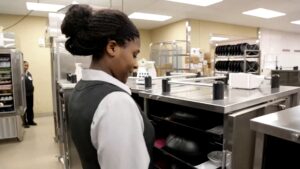
Eliminate it with autonomous mobile robots.
You and your team know how to create menus, plate a modified diet, hold temperature, and turn a dish room. That’s the work. That’s what they trained for and what they’re good at.
What breaks the operation is everything around it: walking the cart to the tower, waiting on the service elevator, walking back for the second cart, and returning at the end of the round for the trays that should have come back twenty minutes ago.
T3 does that part.
It finds the cart, drives underneath it, lifts it, and takes it where it’s supposed to go. It comes back for the empties. It does the same thing at 6 a.m. Sunday morning that it does at noon on a Tuesday.
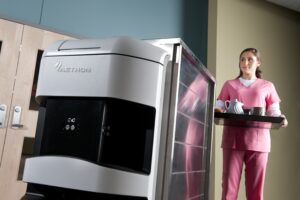
T3 moves the carts. Your team serves the meal.
✓ Meal rounds that start on time because the cart is already there
✓ Predictable and consistent tray retrieval instead of whenever someone is free or at the very tail end of meal service.
✓ Room service delivery that holds up on evenings, weekends and holidays
✓ Carts put where and when your workflow needs them
THE DINING CONCIERGE
Your best people are good with patients.
But the cart won't let them prove it.
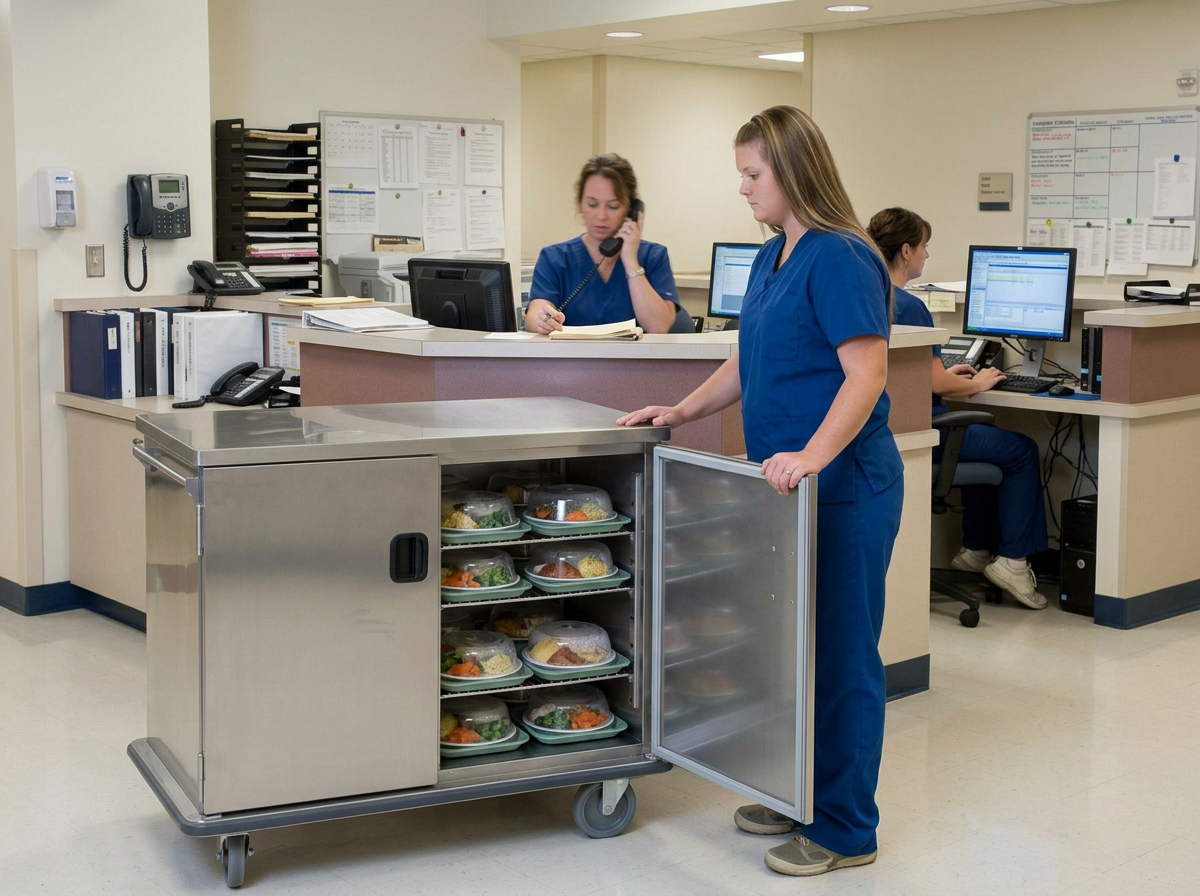
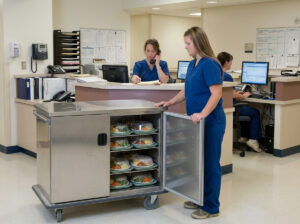
A concierge is a high-value food service position that you can't staff because everyone is moving carts.
The idea is simple, and it’s spreading fast: put a person on the floor instead of behind a cart. Someone who helps the patient at the bedside. Someone the nurse can hand the food question to instead of absorbing it herself.
Almost every director who has looked at a concierge program says the same two things. It works. And we can’t staff it.
The hours already exist inside your department but they’re being spent in corridors and service elevators.
When the cart moves itself, those hours can get returned to the nursing unit.
✓ A familiar face at every meal instead of a tray that simply appears
✓ Nurses handed their time back — no more fielding menu questions and missing trays
✓ Intake actually observed, so poor appetite reaches the dietitian instead of surfacing at discharge
✓ Fewer late trays and remakes, because someone on the unit catches the problem first
✓ Service recovery in the moment, not on a survey thirty days later
THE DINING CONCIERGE
Your best people are good with patients.
But the cart won't let them prove it.
A concierge is a high-value food service position that you can't staff because everyone is moving carts.
The idea is simple, and it’s spreading fast: put a person on the floor instead of behind a cart. Someone who helps the patient at the bedside. Someone the nurse can hand the food question to instead of absorbing it herself.
Almost every director who has looked at a concierge program says the same two things. It works. And we can’t staff it.
The hours already exist inside your department but they’re being spent in corridors and service elevators.
When the cart moves itself, those hours can get returned to the nursing unit.
✓ A familiar face at every meal instead of a tray that simply appears
✓ Nurses handed their time back — no more fielding menu questions and missing trays
✓ Intake actually observed, so poor appetite reaches the dietitian instead of surfacing at discharge
✓ Fewer late trays and remakes, because someone on the unit catches the problem first
✓ Service recovery in the moment, not on a survey thirty days later
WE UNDERSTAND WHAT YOU’RE UP AGAINST
We know what breakfast looks like when you’re two people short.
We understand the job you have to do and we can help you get it done.
We’ve spent more than two decades inside hospitals — in the kitchens, the service corridors and the back elevators — watching what it actually takes to get a tray from the assembly line to a patient’s bedside while it’s still hot.
We’ve watched a second cart sit on a dock because the first one took the only person available. We’ve heard directors describe their department as a delivery service that happens to own a kitchen. We’ve seen what an unreturned tray cart does to a dish room schedule, and what a delayed dish room does to the next meal period.
Not a warehouse. Not a distribution center. A hospital, with food safety standards, diet accuracy requirements, and a patient waiting.
That’s why the T3 exists. It was engineered for the heavy, high-volume, recurring loads a hospital moves every single day — and meal carts are the most predictable, most schedule-driven, most unforgiving of all of them.
THE PLAN
Four steps to automate your tray delivery and return
No need for a pilot program that eats a year. We've done this before and will just get to work when you're ready.
1. Book a Call
We will start with you.
Tell us about your meal periods, tray volumes, room service model, cart types, dish room flow and the shifts you struggle to cover. We’ll put together a presentation, proposal and quote so you can plan for mobile robots one step at a time.
2. We Design Workflow
We build a detailed workflow design: delivery points and galleys, routes, elevator use, meal-period timing, retherm and tray-retrieval cycles, dish room return flow, and 24-hour coverage.
Simulation confirms you have the right number of robots to hit every meal period on time before you commit to anything.
3. We Implement
We deploy the robots and the people who make it work. Nobody in your organization needs to be a robot expert. Our project managers and installers coordinate with nutrition, nursing and IT so the rollout doesn’t land on your desk alone.
4. Robots Deliver Meals
T3 runs day and night, weekends and holidays. Our Command Center and Robot Operations Center monitors every robot 24/7, so uptime is our job and not your staff’s.
THE PLAN
Four steps to automate your tray delivery and return.
No need for a pilot program that eats a year. We've done this before and will just get to work when you're ready.
1. Book a Call
We will start with you.
Tell us about your meal periods, tray volumes, room service model, cart types, dish room flow and the shifts you struggle to cover. We’ll put together a presentation, proposal and quote so you can plan for mobile robots one step at a time.
2. We Design Workflow
We build a detailed workflow design: delivery points and galleys, routes, elevator use, meal-period timing, retherm and tray-retrieval cycles, dish room return flow, and 24-hour coverage.
Simulation confirms you have the right number of robots to hit every meal period on time before you commit to anything.
3. We Implement
We deploy the robots and the people who make it work. Nobody in your organization needs to be a robot expert. Our project managers and installers coordinate with nutrition, nursing and IT so the rollout doesn’t land on your desk alone.
4. Robots Deliver Meals
T3 runs day and night, weekends and holidays. Our Command Center and Robot Operations Center monitors every robot 24/7, so uptime is our job and not your staff’s.
How do mobile robots help hospital nutrition teams?
In this video Mercy Healthcare explains the difference robots make.
How do mobile robots help hospital nutrition teams?
In this video Mercy Healthcare explains the difference robots make.
MEAL AND TRAY LOGISTICS AUTOMATED
It moves your tray carts with food delivery or with tray returns
T3 locates the cart, drives itself underneath, lifts it and secures it. No one has to load it or push it. When it arrives, it lowers the cart, releases it and drives away on its own. Full cart, empty cart, tray cart, retherm cart, bulk supply cart — the exchange works the same way every time.
✓ High capacity. T3 hauls up to 750 lbs. T3XL handles the heaviest loads up to 1,000 lbs.
✓ Your carts or ours. We can retrofit your existing tray and retherm carts onto a robot-compatible base, or replace aging carts with modern, ergonomic, robot-ready models.
✓ Cross-department sharing. The same fleet can run meal delivery during the day and clean linen at night.
✓ Staff notification on arrival. Units can be alerted the moment a cart lands, so trays get passed while they’re hot.
MEAL AND TRAY LOGISTICS AUTOMATED
It moves your tray carts with food delivery or with tray returns
T3 locates the cart, drives itself underneath, lifts it and secures it. No one has to load it or push it. When it arrives, it lowers the cart, releases it and drives away on its own. Full cart, empty cart, tray cart, retherm cart, bulk supply cart — the exchange works the same way every time.
✓ High capacity. T3 hauls up to 750 lbs. T3XL handles the heaviest loads up to 1,000 lbs.
✓ Your carts or ours. We can retrofit your existing tray and retherm carts onto a robot-compatible base, or replace aging carts with modern, ergonomic, robot-ready models.
✓ Cross-department sharing. The same fleet can run meal delivery during the day and clean linen at night.
✓ Staff notification on arrival. Units can be alerted the moment a cart lands, so trays get passed while they’re hot.
COVERAGE THAT DOESN’T CALL OUT
It works the holidays and weekend shifts you can't staff.
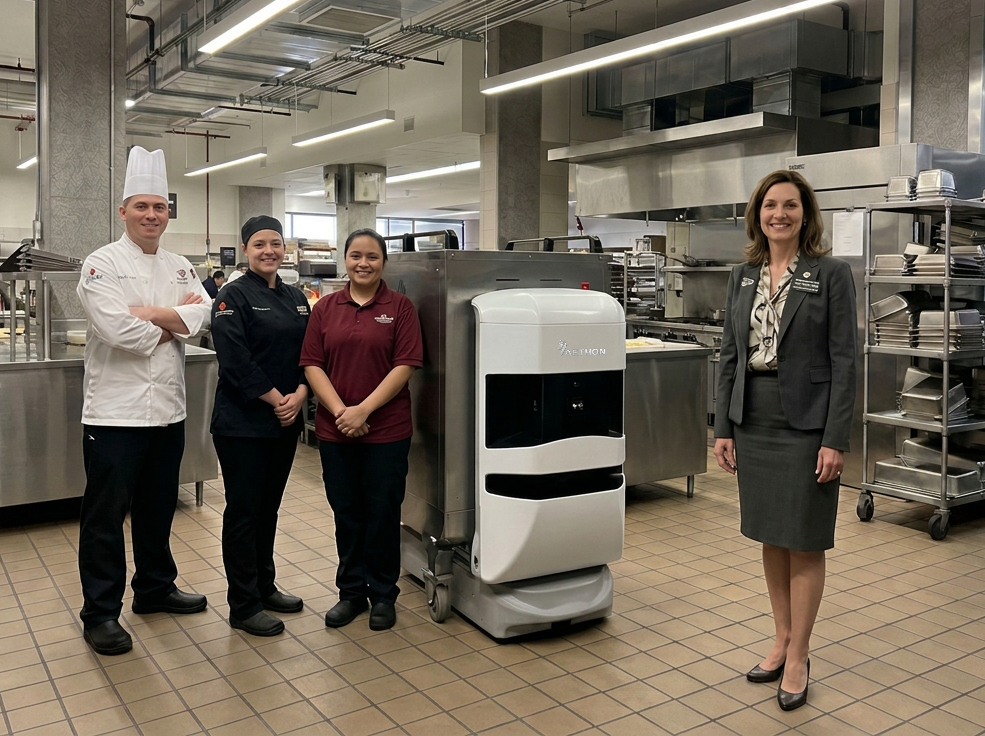
Breakfast still has to go out on New Year’s Day. T3 runs up to 8 hours on a charge and returns to its dock on its own between runs, which keeps it continuously available. The dock plugs into a standard wall outlet, so there’s no infrastructure project standing between you and your first meal round.
Up to 8 hours of runtime.
Autonomous return-to-dock between runs keeps it continuously available.
Coverage that holds on nights, weekends and holidays
COVERAGE THAT DOESN’T CALL OUT
It works the holidays and weekend shifts you can't staff.
Breakfast still has to go out on New Year’s Day. T3 runs up to 8 hours on a charge and returns to its dock on its own between runs, which keeps it continuously available. The dock plugs into a standard wall outlet, so there’s no infrastructure project standing between you and your first meal round.
Up to 8 hours of runtime.
Autonomous return-to-dock between runs keeps it continuously available.
Coverage that holds on nights, weekends and holidays
AUTONOMOUS NAVIGATION
Nobody has to hold the elevator or clear a path.
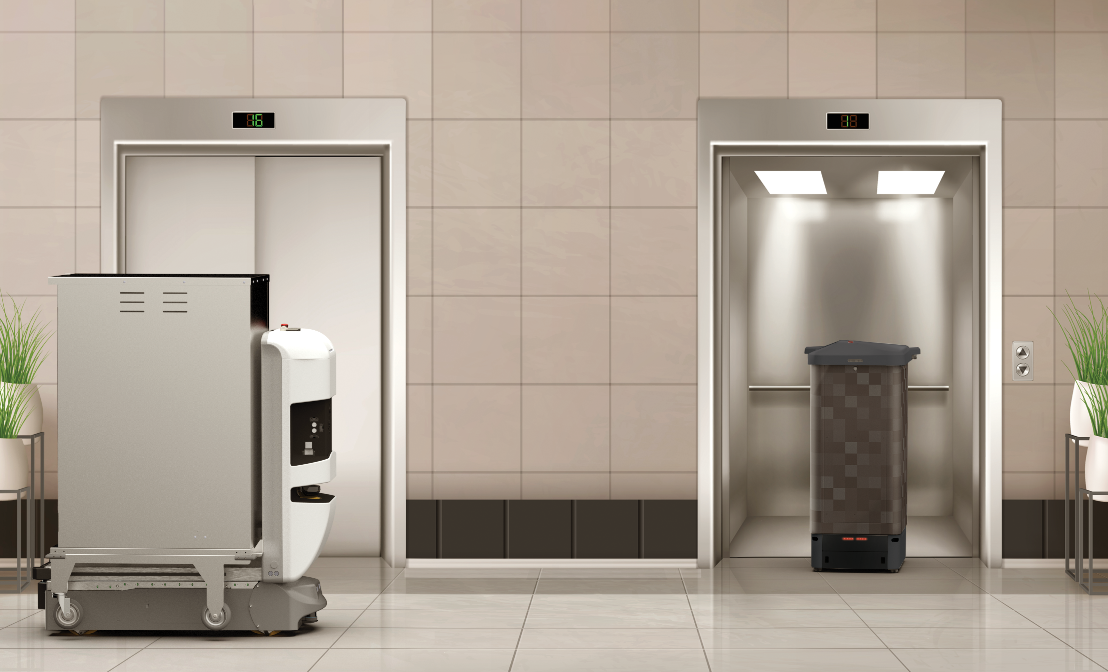
It calls its own elevator, waits for an empty cab, and opens its own doors.
An array of sensors and LiDAR combined with its omnidirectional drive lets T3 move through crowded corridors, nursing units and service areas without an escort.
Boundary-less mapping across floors and levels.
Full elevator integration across all brands.
Auto opening door system integration
Omnidirectional locomotion for tight service corridors and doorways
Safe around patients, staff and visitors
AUTONOMOUS NAVIGATION
Nobody has to hold the elevator or clear a path.
It calls its own elevator, waits for an empty cab, and opens its own doors.
An array of sensors and LiDAR combined with its omnidirectional drive lets T3 move through crowded corridors, nursing units and service areas without an escort.
Boundary-less mapping across floors and levels.
Full elevator integration across all brands.
Auto opening door system integration
Omnidirectional locomotion for tight service corridors and doorways
Safe around patients, staff and visitors
WHAT SUCCESS LOOKS LIKE
What changes in the first ninety days?
| TODAY | TOMORROW |
| Staff walking loaded tray carts to towers and empties back | Staff serving patients and running the tray line |
| Meals arriving late and cold when a cart waits on an elevator | Meal rounds that start on time, every period |
| Soiled trays sitting in the room or on the units affecting cleanliness | Consistent tray retrieval back to the dish room |
| Overtime and agency labor covering nights and holidays | Coverage that doesn’t call out |
| Room service delivery limited by who’s available | On-demand delivery your model can actually provide |
You've probably made the case for more dietary FTEs.
This is the case that scales and gets approved.
WHAT SUCCESS LOOKS LIKE
What changes in the first ninety days?
| TODAY | TOMORROW |
| Staff walking loaded tray carts to towers and empties back | Staff serving patients and running the tray line |
| Meals arriving late and cold when a cart waits on an elevator | Meal rounds that start on time, every period |
| Soiled trays sitting in the room or on the units affecting cleanliness | Consistent tray retrieval back to the dish room |
| Overtime and agency labor covering nights and holidays | Coverage that doesn’t call out |
| Room service delivery limited by who’s available | On-demand delivery your model can actually provide |
You've probably made the case for more dietary FTEs.
This is the case that scales and gets approved.
The food service teams at these health systems don't push carts.
Aethon’s autonomous mobile robot fleets are already running meal delivery across major health systems nationwide.

Sixteen mobile robots deliver meals and return trays.
Their robots travel over 6,000 miles per year and make over 100,000 deliveries.
Learn more about their overall project in this video -> HERE

Six T3 robots at Franciscan Health – Crown Point are shared between dietary and linen services and they perform over 22,000 trips and travel 1,000 miles .

Ten T3 robots moving meal carts travel 5,500 miles and make over 160,000 deliveries annually and enable their concierge model of service.
This is how they describe their robots to their patients -> HERE

Six robots shared between dietary and linen departments perform over 30,000 deliveries and cover over 3,000 miles annually for a single UPMC facility.
BOOK A CALL
Let's talk about your food service operation.
Imagine what it would mean for your team, your patients and your scores if moving carts wasn't anybody's job anymore.
Book a 30-minute exploratory call with one of our food service consultants. Tell us your meal periods, tray volumes and where delivery breaks down, and we’ll show you exactly what T3 would do in your building and what it would give back to your team
"*" indicates required fields
BOOK A CALL
Let's talk about your food service operation.
Imagine what it would mean for your team, your patients and your scores if moving carts wasn't anybody's job anymore.
Book a 30-minute exploratory call with one of our food service consultants. Tell us your meal periods, tray volumes and where delivery breaks down, and we’ll show you exactly what T3 would do in your building and what it would give back to your team
"*" indicates required fields